


 Cart
Cart
 sales@molnova.com



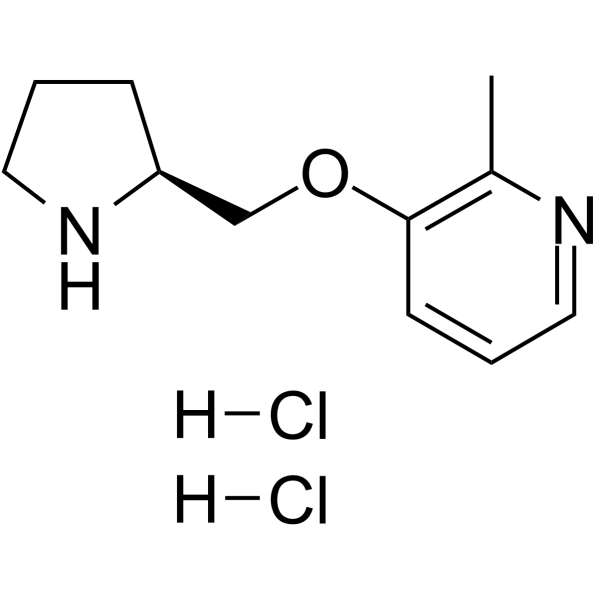
Pozanicline dihydrochloride
CAS No. 161416-61-1
Pozanicline dihydrochloride( ABT-089 dihydrochloride )
Catalog No. M26390 CAS No. 161416-61-1
Pozanicline dihydrochloride is an orally bioavailable agonist of nicotinic acetylcholine receptor (nAChR) (Ki = 16.7 nM).
Purity : >98% (HPLC)
 COA
Datasheet
HNMR
HPLC
MSDS
Handing Instructions
COA
Datasheet
HNMR
HPLC
MSDS
Handing Instructions
| Size | Price / USD | Stock | Quantity |
| 5MG | 307 | Get Quote |


|
| 10MG | 511 | Get Quote |
|
| 25MG | 920 | Get Quote |
|
| 50MG | 1380 | Get Quote |
|
| 100MG | Get Quote | Get Quote |
|
| 200MG | Get Quote | Get Quote |
|
| 500MG | Get Quote | Get Quote |
|
| 1G | Get Quote | Get Quote |
|
Biological Information
-
Product NamePozanicline dihydrochloride
-
NoteResearch use only, not for human use.
-
Brief DescriptionPozanicline dihydrochloride is an orally bioavailable agonist of nicotinic acetylcholine receptor (nAChR) (Ki = 16.7 nM).
-
DescriptionPozanicline dihydrochloride is an orally bioavailable agonist of nicotinic acetylcholine receptor (nAChR) (Ki = 16.7 nM)(In Vitro):Pozanicline dihydrochloride is an α4β2-selective nAChR agonist, which binds to rat brain α4β2 nAChR (Ki = 17 nM) while binding to α7 nAChR is insignificant. Moreover, one α6β2 nAChR subtype is particularly sensitive to Pozanicline dihydrochloride(EC50 = 0.11 μM).(In Vivo):Mice underwent chronic nicotine administration (12.6 mg/kg/day or saline for 12 days), followed by 24 h of withdrawal. At the end of withdrawal, mice received 0.3 or 0.6 mg/kg Pozanicline dihydrochloride and were trained and tested for CFC. Nicotine withdrawal produced deficits in CFC that were reversed by acute Pozanicline dihydrochloride. Cued conditioning was not affected. Modulation of hippocampal learning and memory using Pozanicline dihydrochloride may be an effective component of novel therapeutic strategies for nicotine addiction.
-
In VitroPozanicline (ABT-089) is a partial agonist at α4β2 nAChR. Moreover, one α6β2 nAChR subtype is particularly sensitive to Pozanicline with an EC50 of 0.11 μM. Pozanicline (ABT-089) shows high selectivity for α6β2 and α4α5β2 nAChR subtypes.
-
In VivoPozanicline (ABT-089; 0.3 mg/kg and 0.6 mg/kg) reverses nicotine withdrawal-induced deficits in contextual fear conditioning. Animal Model:Adult male C57BL6/J mice at 8-12 weeks of age.Dosage:0.3 mg/kg and 0.6 mg/kg Administration:Treated 5 min before training and testing for contextual fear conditioning Result:A dose of0.3 mg/kg and 0.6 mg/kg ameliorated nicotine withdrawal-induced cognitive deficits in contextual fear conditioning.
-
SynonymsABT-089 dihydrochloride
-
PathwayCell Cycle/DNA Damage
-
TargetAChR
-
Recptor——
-
Research Area——
-
Indication——
Chemical Information
-
CAS Number161416-61-1
-
Formula Weight265.18
-
Molecular FormulaC11H18Cl2N2O
-
Purity>98% (HPLC)
-
SolubilityIn Vitro:?H2O : 100 mg/mL (377.10 mM)
-
SMILESCl.Cl.Cc1ncccc1OC[C@@H]1CCCN1
-
Chemical Name——
Shipping & Storage Information
-
Storage(-20℃)
-
ShippingWith Ice Pack
-
Stability≥ 2 years
Reference
1.Varela E, Tien M. Effect of pH and oxalate on hydroquinone-derived hydroxyl radical formation during brown rot wood degradation. Appl Environ Microbiol. 2003 Oct;69(10):6025-31.
molnova catalog



related products
-
YM-58790
YM-58790 free base is a potent mAChR antagonist that inhibits M1 mAChR, M2 mAChR, and M3 mAChR with Ki values of 28 nM, 260 nM, and 15 nM, respectively.
-
(Rac)-VU 6008667
(Rac)-VU 6008667 is a selective negative allosteric modulator of the muscarinic acetylcholine receptor subtype 5 (M5 NAM), with an IC50 of 1.8 μM and a pIC50 of 5.75, exhibiting high CNS penetration.
-
CP-810123
CP-810123 is a new alpha 7 nAChR agonist for the treatment of cognitive impairment associated with psychiatric or neurological disorders such as schizophrenia and Alzheimer's disease.
